Concrete, pavers and pool decks for Sarasota's coast, built for salt, sand and a 91-degree July
Poured concrete and paver hardscape for Sarasota, the keys, Palmer Ranch, Venice, North Port and the Englewood coast. Local cost ranges with a date on them, the permit office for your address, and the flood, salt and turtle-lighting rules explained before you spend anything.
(941) 274-3561Call or text- Insured
- Free written estimate
- Sarasota County and the Charlotte coast
- Concrete and pavers, priced separately
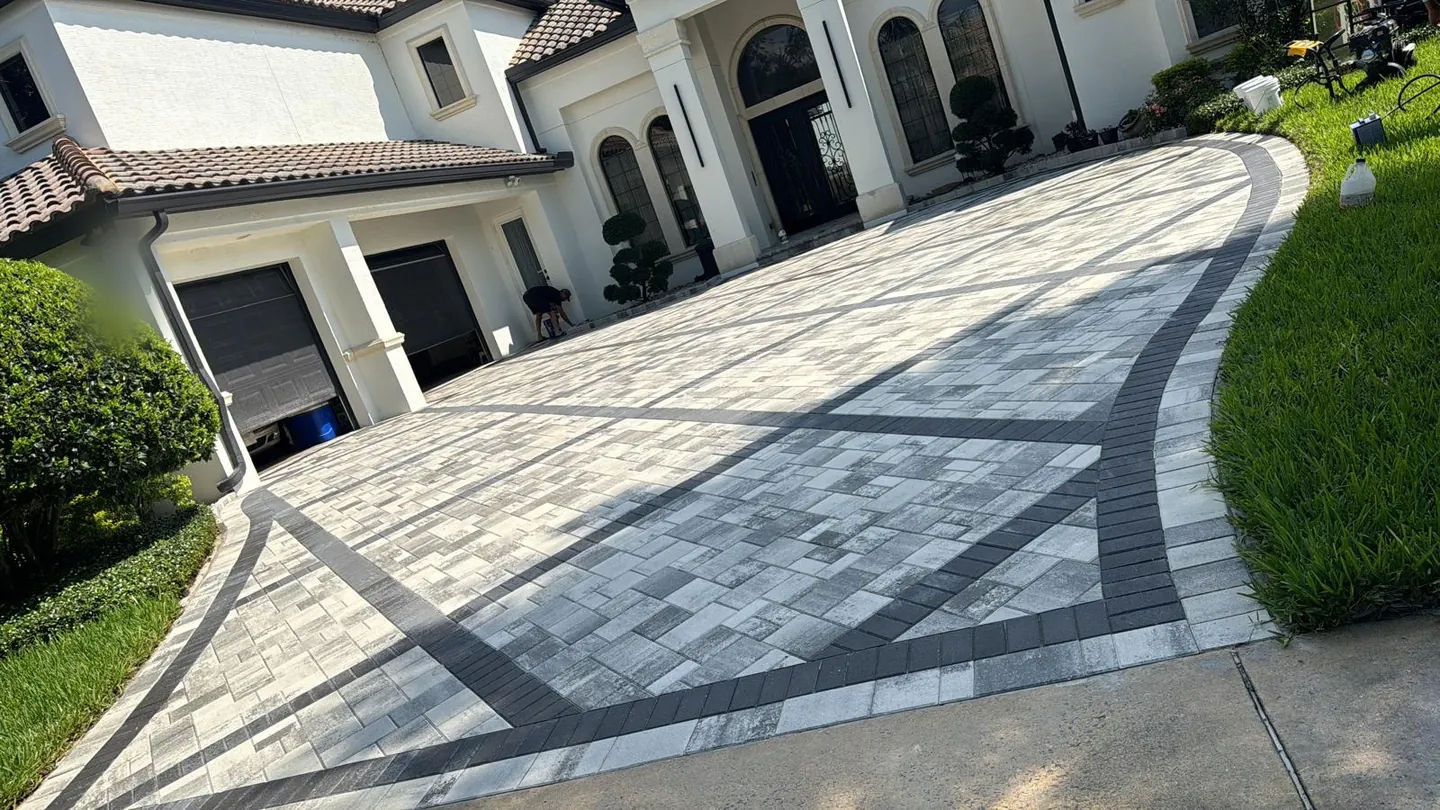
Job photo from our crews.
- Service area
- Sarasota County and the Charlotte County coast, 40 miles from Sarasota
- Jurisdictions covered
- Sarasota County, City of Sarasota, Venice, North Port, Longboat Key, Charlotte County
- Two trades
- Poured concrete and pavers, planned and priced separately
- Status
- Insured. Free written estimates
Concrete and pavers, one coast
Sarasota homeowners rarely need "concrete" or "pavers" in the abstract. They need a pool deck that doesn't burn feet in August, a driveway that survives the water table under Palmer Ranch, or a lanai floor on Siesta Key that can be hosed off after the next surge. So the work is organized around those decisions. Concrete covers everything poured in place; pavers cover everything set on a compacted base. Each service page tells you what the work is, what it costs in this market on a stated date, how long it takes, which office issues the permit, and what goes wrong here that doesn't go wrong in Ocala.
We work in Sarasota County first, then on the Charlotte County coast between Englewood and Port Charlotte. Lakewood Ranch, Bradenton, Parrish and the rest of Manatee County are outside the area we work.
Poured concrete
- Concrete pool decks: New decks, extensions and condo decks poured with a real slope to the drain and a texture your feet can stand in July.
- Concrete driveways: Replacement and widening on Myakka sand, with the base, joints and apron detail each jurisdiction expects.
- Patios and lanai slabs: Broom, exposed-aggregate and colored slabs sized for the cage you have or the one you're planning.
- Stamped and decorative: Patterned and stained concrete sealed for Gulf sun, with honest notes on slip and resealing.
- Slabs and pads: Shed, generator, AC, hot-tub and boat-lift pads engineered for the load, not the price sheet.
- Sidewalks and walkways: Entry walks, side paths and trip-hazard replacements that meet the county's grade.
- Repair and leveling: Cracks, spalling and settled slabs diagnosed before anyone sells you a tear-out.
- Resurfacing and overlays: Pool deck renewal over sound slabs, with a clear line on when an overlay is the wrong answer.
- Architectural concrete: Honed, board-formed and cast finishes for modern Sarasota entries and steps.
Pavers and hardscape
- Paver pool decks: Concrete pavers, travertine, shellstone and porcelain laid on a base that drains, around residential and condo pools.
- Travertine and shellstone: Natural stone with the sealing cycle and salt-pool facts stated up front.
- Marble and porcelain: Large-format and luxury lines, including Belgard, for lanais that read as interior floors.
- Paver driveways: Vehicular pavers, brick and permeable systems with base depths matched to a high water table.
- Paver patios and lanais: New patios, lanai floors and overlays where the slab underneath earns it.
- Walkways and steps: Entry paths and steps in pavers and stone, with lighting that passes turtle season on the islands.
- Sealing and cleaning: Cleaning, polymeric re-sanding and sealer choice tuned to how far you are from the Gulf.
- Repair and storm restoration: Sunken, shifted and surge-damaged pavers reset on a rebuilt base, documented for your insurer.
- Walls, fire pits, kitchens: Seat walls, decorative retaining walls and outdoor-kitchen bases in block and stone.
- Artificial turf: Turf inlays and side yards paired with pavers where grass gives up.
- Hardscape lighting: Path, step and wall lights built into the hardscape, amber and shielded where the ordinance requires.
What does a pool deck cost in Sarasota in 2026?
Published Sarasota-area pricing on September 10, 2026 puts installed concrete pavers around $13 to $16 per square foot, travertine around $20 to $26, and a decorative overlay on an existing slab at $10 to $15. A 700-square-foot deck therefore runs roughly $9,000 to $18,000 depending on material, not counting demolition, drainage fixes or coping. These are planning ranges, not quotes.
The full breakdown by material, deck size and condition is in the pool deck cost guide, and the method behind every number on this site is on the data and methods page.
Do I need a permit to replace a driveway or pool deck here?
It depends on the jurisdiction, not the county line alone. Unincorporated Sarasota County requires a culvert permit or right-of-way use permit for anything touching the county road frontage; the City of Sarasota treats the apron between sidewalk and street as city property; Charlotte County permits every slab, pavers included. Details per office are on the permits page.
Start with the permits page or type your address into the permit, flood-zone and setback finder. Each jurisdiction page links the official portal (Accela for the county, the FTG portal for the City of Sarasota, eTRAKiT for Venice, Click2Gov for North Port) and says who normally pulls the permit.
Which pool deck surface stays coolest barefoot in July?
By the physics: light color first, then porosity, then mass. Light, porous stone (shellstone and tumbled travertine) is expected to stay coolest underfoot; light concrete pavers, a light cool-deck overlay and light broom concrete sit in the middle; gray broom concrete runs warm; charcoal pavers and dark stamped concrete get hottest. Nobody has published a measured Sarasota comparison, so treat any exact degree difference as a claim.
The surface comparison has the full order, the wet slip rating to ask for, and what color, mass and texture do to a deck at 2 p.m. If an installer tells you travertine is "25 degrees cooler", ask where the thermometer was.
What changes when the property is in a flood zone on the keys?
Three things. The NFIP 50 percent rule limits improvements to the building, but driveways, pool decks and other site work sit outside that calculation, so hardscape rarely triggers it. Anything seaward of Sarasota County's Gulf Beach Setback Line needs a coastal setback variance, pool decks included. And from May 1 to October 31, any light visible from the beach must be long-wavelength and shielded.
Those three rules, with the code sections and the offices that enforce them, are on flood zones and the 50% rule and sea turtle lighting. The coastal guide covers what salt and surge do to concrete and pavers over a decade.
Where the crew works, and who issues the permit
Every locality below has a page with the jurisdiction, the predominant flood zone, the soil series under the lots, the housing stock and the drive time from Sarasota. In Sarasota County we offer every service. On the Charlotte County coast, inside 40 miles, we schedule four: pool decks, paver driveways, concrete driveways and concrete repair.
| Locality | Permit jurisdiction | Drive from Sarasota | Predominant flood zone |
|---|---|---|---|
| Sarasota | City of Sarasota | 0 to 15 minutes | X inland |
| Fruitville & Bee Ridge | Sarasota County | 10 to 20 minutes | mostly X |
| Gulf Gate | Sarasota County | 10 to 15 minutes | X in the interior blocks |
| Siesta Key | Sarasota County | 15 to 25 minutes via the Siesta Drive or Stickney Point bridges | AE across most of the island, VE on the Gulf front |
| Palmer Ranch | Sarasota County | 15 to 20 minutes | mostly X with AE along the lake and preserve edges |
| Longboat Key | Town of Longboat Key | 25 to 40 minutes via the Ringling Causeway and St. Armands, or from the north via Cortez Road and the Longboat Pass bridge | AE and VE island-wide |
| Osprey & Casey Key | Sarasota County | 20 to 25 minutes on US-41; Casey Key by the Blackburn Point swing bridge | X and AE inland |
| Nokomis & Laurel | Sarasota County | 25 to 35 minutes by I-75 or US-41 | AE around Dona and Roberts bays and Shakett Creek |
| Venice | City of Venice | 30 to 40 minutes | AE and VE on Venice Island and along the Intracoastal |
| South Venice & Venice Gardens | Sarasota County | 35 to 45 minutes | AE along Lemon Bay and Alligator Creek |
| North Port | City of North Port | 40 to 50 minutes by I-75 | X across most of the GDC grid |
| Englewood & Manasota Key | Sarasota County north of the county line, Charlotte County south of it | 45 to 60 minutes by SR-776 | AE along Lemon Bay |
| Locality | Permit jurisdiction | Drive from Sarasota | Predominant flood zone |
|---|---|---|---|
| Port Charlotte | Charlotte County | 50 to 65 minutes by I-75 or US-41 | AE along the canals and Charlotte Harbor |
| Rotonda West | Charlotte County | 50 to 60 minutes by SR-776 | AE around the canal system and the Cape Haze peninsula |
| Placida, Grove City & Cape Haze | Charlotte County | 55 to 65 minutes by SR-776 and Placida Road | AE and VE along Lemon Bay, Gasparilla Sound and the Cape Haze peninsula |
County-level rules are on the Sarasota County overview and the Charlotte County overview. Manatee County (Lakewood Ranch, University Park, Bradenton, Palmetto, Anna Maria Island) and south Hillsborough are outside the area we work; the service area page has the full list.
Five things the Gulf side does to hardscape
Most concrete advice online was written for Georgia clay or Midwest freeze. The Suncoast fails surfaces differently, and the service pages here are built around these five mechanisms.
- A water table under 10 inches for months. The USDA describes Myakka fine sand, the soil under most of Sarasota County, as poorly drained with a seasonal high water table within 10 inches of the surface for two to six months a year. A base that isn't compacted in lifts and pitched to drain will pump fines and settle, and the slab or paver field settles with it.
- Salt from three directions. Spray off the Gulf, brackish bay water in the canals and salt-chlorinated pool water all move chloride into concrete and stone. On the islands, sealer life is closer to 18 to 24 months than the 3 years quoted inland, and unsealed limestone-family pavers (travertine, shellstone) around salt pools flake at the waterline first.
- Ninety-degree afternoons and 7 to 9 inches of rain a month. NOAA's 1991 to 2020 normals for Sarasota-Bradenton put July and August highs at 91 degrees and August rainfall at 9.11 inches. Pours are scheduled for the morning, joints are cut the same day, and cure protection matters more than mix design.
- Storm surge that moves sand and pavers. Helene pushed a measured 6.68-foot surge onto Longboat Key in September 2024 and Milton followed two weeks later. Surge washes out joint sand, floats edge restraint and leaves salt in the base. The paver repair page says what to reset and what to rebuild.
- Rules that change every few miles. The City of Sarasota, Sarasota County, Venice, North Port, Longboat Key and Charlotte County each permit flatwork differently, and barrier-island lots add the setback line and turtle lighting. That's why this site has a permit page per office instead of one paragraph that says "check with your local building department".
How an estimate works
A request through the form or the phone gets a callback the same or next business day. For most projects we visit, measure, check the slope with a level and a hose if the drainage is in question, and look at what's under the existing surface. Seasonal owners can start with a video walkthrough instead; the site plan or survey from your closing documents is enough to draft a scope.
You get a written scope with the square footage, thickness or paver system, base depth, reinforcement, drainage plan, permit responsibility, schedule window and the price. The permit and any ARC packet are prepared before a start date is set. During the job, photos go out daily. At the end you get the care sheet, the sealing schedule for your distance from the coast, and the written workmanship warranty terms that apply to the work.
The snowbird project guide walks through the remote version step by step, and the deposits and warranties guide explains what Florida law says a deposit and a written contract should look like before you sign anything.
Planning tools
Recent work
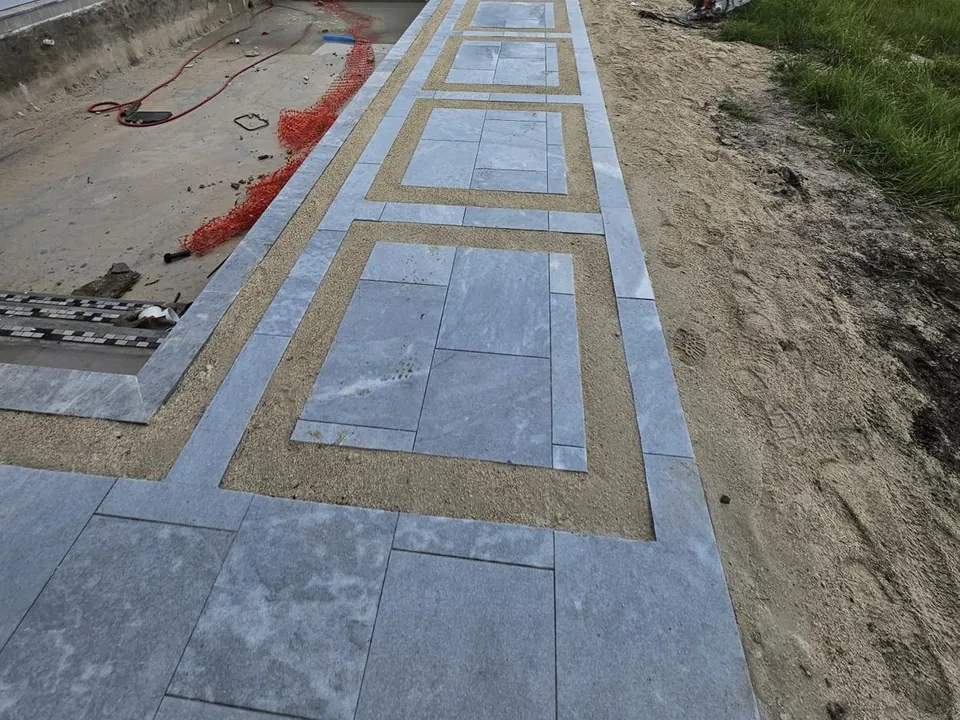
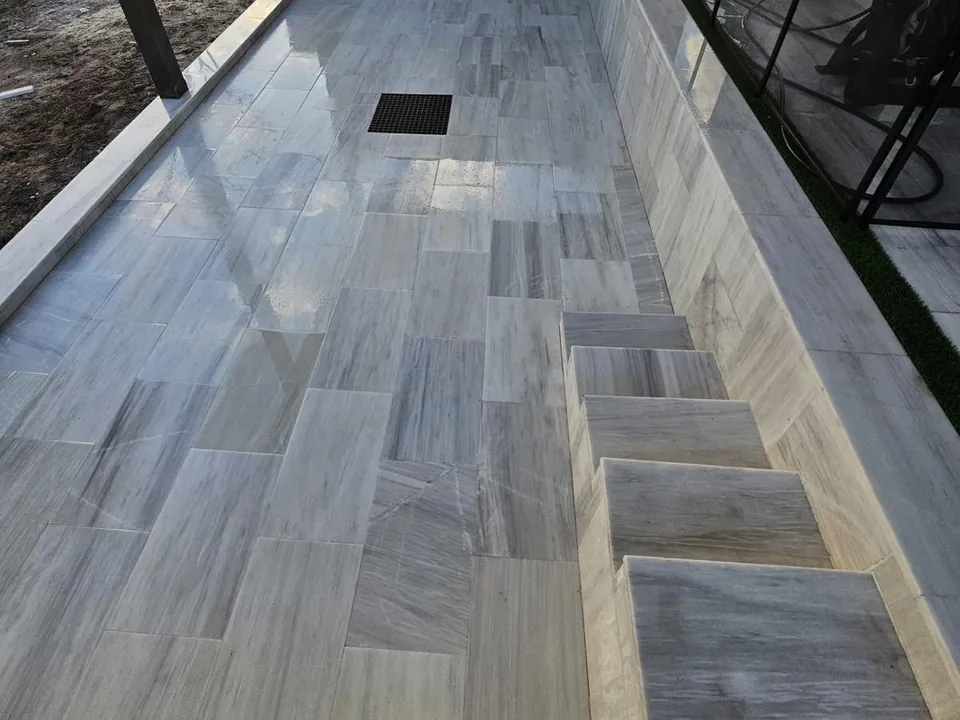
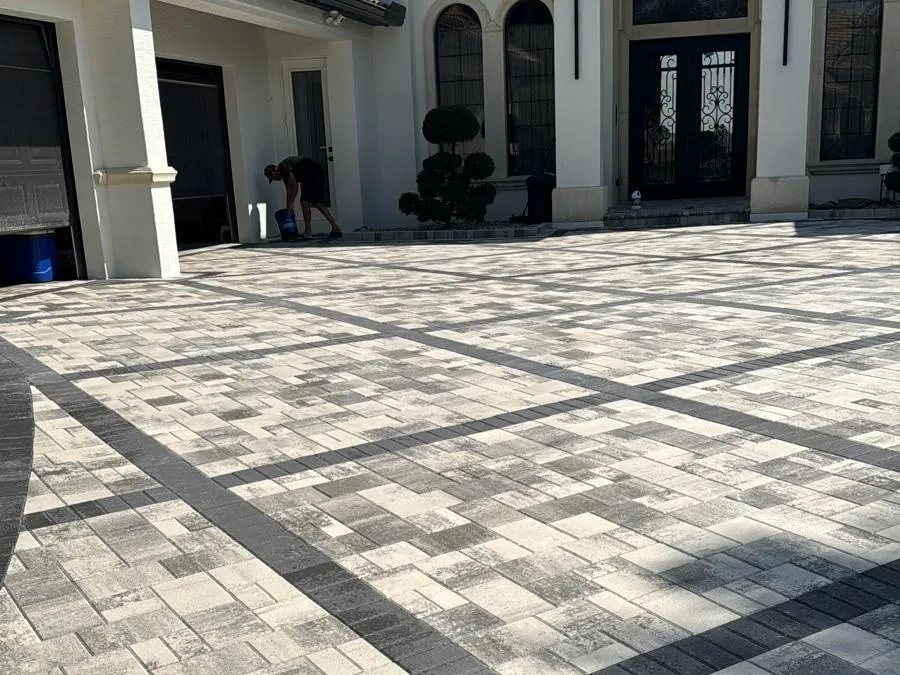
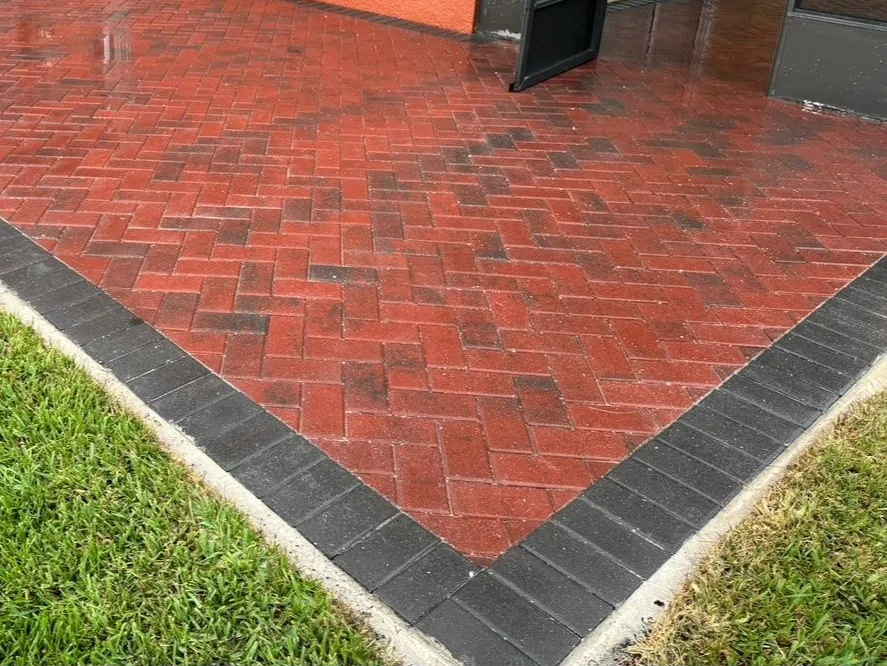
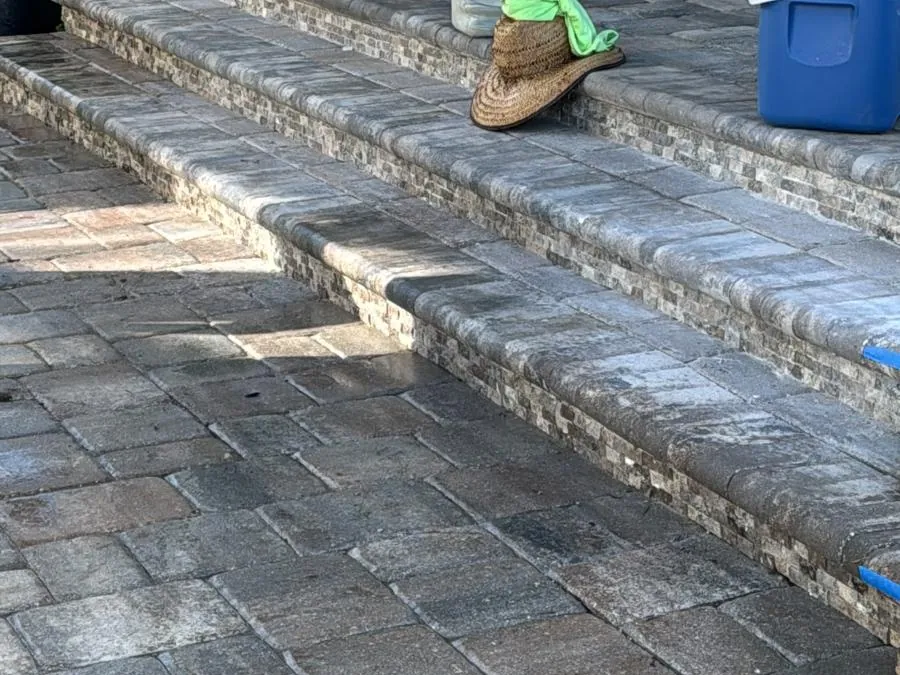
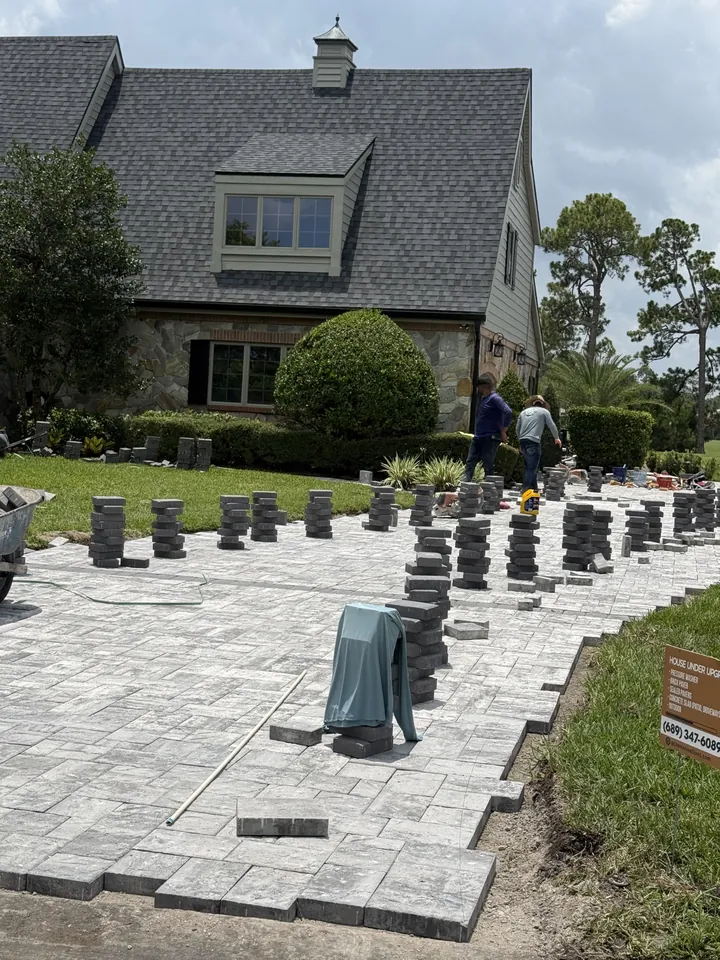
Job photos from our crews. New projects are added to the gallery as they're completed and documented with the city, material, square footage and the challenge on the lot.
What our written scope contains
A scope you can compare line by line, not a total on a business card. Square footage measured on site or from your survey; thickness or paver system; base depth and material, with geotextile where the subgrade pumps; reinforcement; joint layout; drainage plan with where the water goes; demolition and disposal; permit responsibility and fees; association packet contents; schedule window with the weather clause stated; payment schedule tied to stages; warranty terms; and the legal name of the entity doing the work.
The point of writing it this way is that you can hand the same list to anyone else who quotes the job. If their number is lower, the scope shows you where: a thinner slab, a shallower base, no geotextile, the permit left to you.
Seasons and scheduling on the Suncoast
| Months | What's happening | What it means for a job |
|---|---|---|
| January to April | Peak population (Sarasota County passes 570,000 in winter) and peak demand | Longest lead times; book two months ahead; dry, cool pours |
| May | Owners leaving; turtle season starts May 1 on the islands | Best month to sign a summer job; lighting swapped to amber |
| June to September | Highs above 90, 6 to 9 inches of rain a month, afternoon storms | Pours at 7 a.m.; joint sand and sealing in dry gaps; shortest lead times |
| August to October | Peak hurricane weeks (Ian 2022, Helene and Milton 2024) | No island pours inside a watch; storm playbook applies |
| November to December | Owners returning; turtle season ends October 31 | Finish line for summer jobs; sealing season opens |
The pour calendar turns the NOAA normals into a start hour for any month, and the snowbird guide lays out the March-to-November plan for owners who spend summers elsewhere.
Straight answers before you call
Who do I deal with when I call Sarasota Concrete?
Us, from the first call to the last inspection. Your request comes straight to Sarasota Concrete, not to a list of bidders, and the estimate, the schedule and the warranty all come from the same company. Our legal business name is printed on the estimate and in the contract before any deposit changes hands.
Do you work on Siesta Key, Longboat Key and Casey Key?
Yes. Barrier-island work is where the flood-zone, setback and sea-turtle lighting rules bite, so every island estimate starts with the FEMA zone and the jurisdiction (Sarasota County for Siesta and Casey Key, the Town of Longboat Key for Longboat) written on the scope.
How fast can a pool deck or driveway be scheduled?
In season (January through April) the calendar is tightest and lead times stretch; June through September opens up but afternoon rain shapes pour days. Ask for a date range when you request the estimate and we'll say what is realistic for your month, not a generic promise.
Are the prices on this site quotes?
No. They're planning ranges compiled from published Sarasota-area pricing on a stated date, plus our own completed jobs as they're documented. A written estimate follows a site visit or a video walkthrough, and that number is the one that counts.
Do you handle the permit and the HOA paperwork?
We handle the permit where the job needs one, and we prepare the ARC packet (site plan, material sample, color, drainage note) for you to submit, since most associations only accept applications from the owner.
What if I'm out of state for the summer?
Most of our seasonal clients are. Video estimates, e-signed scope, daily photo reports and a hand-off to your property manager are standard, and the schedule is built so the work is finished before you fly back in November.
Tell us more about the project
The hero form is four fields because that is all a first contact needs. This one asks for the location, a description and a photo, which is what makes the first call short. Call or text (941) 274-3561 if you prefer.
How to compare the estimates you are about to collect
Most people reading this page will get two or three quotes. The useful ones are comparable line by line; the rest are a number on a page. Five questions separate them, and none of them require knowing anything about concrete.
- How deep is the base, and in how many lifts? On this soil a base compacted in 3-inch lifts is the difference between thirty years and five. A quote that does not name a depth is not describing the job.
- Is demolition and haul-off in the number? It is $2 to $4 per square foot, and it is the most common reason two quotes look thousands apart.
- Which office issues the permit, and who applies for it? Six different offices cover this service area and they do not have the same rules. A company that cannot name yours has not looked at your address.
- When are the control joints cut, or where does the edge restraint fix? Same-day joints on concrete, restraint fixed to the base on pavers. Both are invisible in a week and decisive in a decade.
- What is the legal name on the contract? You cannot check insurance or lien history against a trade name; the certificate and the Sunbiz record carry the legal name.
The full line-by-line checklist, with the deposit norms and Florida's lien rules, is on the pricing guide.
Four questions worth asking anyone who quotes your job
An estimate is easier to judge when you know what to ask. These four separate a careful bid from a fast one on this coast, and we expect to be asked them too.
- What is under the surface? On Sarasota's sands the base decides how long a driveway or a deck stays flat. Ask for the base depth, the material and whether a geotextile goes down, in writing.
- Where does the water go? A slope arrow and a named outlet, a swale, a yard drain or the street, belong on the drawing. Flat work that holds water at the low edge is the most common failure inland.
- Who handles the permit and the association? Some jobs need a county or city permit, most communities need an ARC approval, and the answer should name who prepares and who submits each one.
- Whose name is on the contract? The legal business name on the estimate should match the certificate of insurance the agent sends you, before a deposit is paid.
Last reviewed September 10, 2026 by Luciano, Owner. First publication.